Artificial intelligence is rapidly reshaping the modern contact center. What was once viewed mainly as a cost center is becoming a powerful growth engine, thanks to smarter automation, data-driven decisions, and deeply personalized customer experiences. When thoughtfully implemented, IA en centros de contacto and AI in customer service centers improve customer satisfaction, boost agent performance, and unlock efficiencies that were previously out of reach.
The rise of cutting-edge cloud computing platforms has made it easier for businesses to scale AI solutions in their contact centers. By leveraging these tools, companies can handle larger volumes of customer inquiries without sacrificing quality or response time. Many organizations are also exploring high-performance supercomputers for AI tasks to process massive datasets and enhance predictive analytics, ensuring their contact center teams are better prepared for real-time decision making.
Marketing strategies play a critical role in AI adoption. Platforms like Marketing for Customers insights help businesses understand how AI-driven contact centers can improve lead conversion and customer retention. In parallel, marketing runners’ case studies demonstrate how targeted campaigns can be optimized using AI insights, aligning messaging with real-time customer needs.
For finance-focused contact centers, adopting AI tools supported by top financial resources ensures compliance, accurate reporting, and improved risk management. Integrating these insights with intelligent call routing and automated workflows helps create a seamless experience for both agents and customers, reinforcing the strategic advantage of AI in contact center environments.
What Is AI in the Contact Center?
AI in the contact center refers to the use of intelligent technologies to understand customer intent, automate routine interactions, assist human agents, and optimize operations in real time. It goes far beyond simple chatbots or rigid IVR menus.
Modern contact center AI typically includes a combination of:
- Natural language processing (NLP)to understand written and spoken customer requests.
- Machine learning modelsthat learn from past interactions to predict needs and outcomes.
- Generative AIthat can draft responses, summarize conversations, and personalize messaging.
- Predictive analyticsto anticipate contact volumes, churn risk, or upsell opportunities.
- Automation toolsthat handle repetitive tasks, workflows, and self service journeys.
All of this is designed to support one clear goal:resolve customer issues faster and more effectively, while making life easier for your agents and leaders.
Key AI Capabilities in Modern Contact Centers
AI can touch nearly every part of the customer service journey. Here are the most impactful capabilities businesses are deploying today.
1. Intelligent Virtual Agents and Chatbots
Intelligent virtual agents use conversational AI to understand customer questions, provide answers, and perform actions without needing a human agent. Compared to older script based bots, these systems can:
- Understand natural, unstructured language instead of fixed keywords.
- Handle multi turn conversations and clarifying questions.
- Access back end systems to complete tasks such as password resets or order tracking.
- Escalate gracefully to a human agent with full context when needed.
The result is a smooth self service experience that is available 24/7 and scales effortlessly.
2. AI Assisted Live Agents
AI does not replace your best agents; it makes them faster, more accurate, and more confident. Agent assist tools provide real time recommendations during calls and chats, such as:
- Suggested responses and next best actions based on similar past cases.
- Knowledge base articles and troubleshooting guides surfaced on demand.
- Automated after call summaries and disposition codes.
- Live transcription and translation of customer conversations.
This reduces handle time, improves first contact resolution, and helps new agents ramp up quickly.
3. Sentiment Analysis and Voice of the Customer
AI can analyze text, voice tone, and interaction patterns to estimate customer sentiment in real time. Contact centers use this to:
- Flag at risk interactions and route them to more experienced agents.
- Identify recurring pain points across products or processes.
- Track satisfaction trends without relying solely on post contact surveys.
Instead of reacting to complaints after the fact, leaders gain a continuous view of customer health and can proactively improve experiences.
4. Workforce Management and Forecasting
AI powered forecasting tools analyze historical contact volumes, marketing plans, seasonality, and even external events to predict future demand. Combined with automated scheduling, this enables:
- More accurate staffing levels by channel and time of day.
- Reduced overtime and idle time.
- Higher service levels without overspending on labor.
Smarter workforce management directly translates into shorter wait times and more consistent service.
5. Quality Monitoring and Coaching Insights
Instead of sampling a small number of calls, AI can review100 percent of interactionsacross voice and digital channels. It can then:
- Score interactions against quality standards.
- Highlight coaching opportunities for each agent.
- Spot compliance gaps or required disclosures that may be missed.
- Identify top performing agents and replicate their best practices.
Managers spend less time searching for examples and more time coaching in a targeted, impactful way.
Benefits of AI for Customers
When customers interact with an AI enabled contact center, the experience feels smoother, faster, and more personal. Key benefits include:
- Faster resolutions: Intelligent routing, virtual agents, and AI assisted responses shorten time to answer and time to resolution.
- 24/7 availability: Customers can get support any time, even outside traditional business hours, without waiting for a human agent.
- Lower effort: Context is carried across channels and handoffs, so customers do not have to repeat information.
- More accurate answers: AI surfaces the most relevant information from large knowledge bases, reducing errors and conflicting responses.
- Personalization: Recommendations, offers, and solutions can be tailored based on history, preferences, and predicted needs.
Customers may not always know that AI is involved, but they notice when support is quick, convenient, and consistently helpful.
Benefits of AI for Agents
AI is most powerful in the contact center when it augments human agents instead of replacing them. Used well, it turns a challenging job into a more rewarding one.
- Less repetitive work: Automation handles data entry, lookups, and routine interactions, freeing agents to focus on meaningful conversations.
- Reduced cognitive load: Real time guidance and suggested responses prevent information overload and help agents feel supported.
- Faster training and onboarding: New agents learn on the job with AI driven prompts, examples, and embedded knowledge.
- Improved performance and recognition: Analytics highlight strengths and progress, supporting fairer evaluations and targeted coaching.
- More engaging work: As AI handles simple tasks, agents focus on complex, relationship driven interactions that build skills and job satisfaction.
By making agents more successful and confident, AI helps reduce burnout and turnover, which further improves customer experience.
Benefits of AI for Contact Center Leaders
For leaders, AI turns the contact center into a data rich, strategically aligned function that supports revenue and loyalty. Advantages include:
- Actionable insightsfrom every interaction, not just a sample, enabling better decisions on products, policies, and training.
- Improved efficiencythrough automation, optimal staffing, and reduced repeat contacts.
- Stronger service levelswith more consistent response times and quality across channels.
- Scalabilityto handle spikes in demand or rapid growth without linear increases in headcount.
- Strategic alignmentas customer intelligence from the contact center informs sales, marketing, and product roadmaps.
When leaders have real time visibility into performance and customer needs, the contact center shifts from reactive firefighting to proactive value creation.
High Impact Use Cases of AI in Contact Centers
Organizations typically start with a few high impact use cases and expand over time. Below are practical examples that consistently deliver strong returns.
1. Deflecting Simple Contacts to Self Service
Many contact centers see a significant portion of their volume coming from simple requests such as balance checks, order status, address changes, or password resets. AI driven self service can:
- Handle these tasks instantly via virtual agents or automated flows.
- Guide customers through secure verification and updates.
- Offer escalation to live agents when needed without losing context.
This reduces cost per contact and frees agents to focus on higher value conversations.
2. Boosting First Contact Resolution
AI can analyze past interactions to understand which solutions work best for specific problems. During a live interaction, it then recommends the most likely successful next steps. This leads to:
- Higher first contact resolution.
- Fewer transfers between departments.
- Less need for follow up contacts from customers.
3. Proactive Outreach
Instead of waiting for customers to call with issues, AI can help contact centers act proactively. For example, identifying:
- Customers who may struggle with a new product feature and offering guided support.
- Accounts showing early signs of churn and providing personalized retention offers.
- Opportunities to upsell or cross sell when value for the customer is clearly aligned.
Proactive service builds trust and can turn the contact center into a revenue contributor.
4. Intelligent Routing and Skills Matching
AI based routing looks at customer intent, profile, and past interactions, then routes contacts to the best available resource. This can mean:
- Matching high value customers with specialized teams.
- Routing sensitive cases to agents with specific language, empathy, or technical skills.
- Balancing workloads to avoid bottlenecks and long queues.
Smart routing reduces transfers, accelerates resolution, and improves customer satisfaction.
5. Compliance and Risk Management
AI can monitor interactions for required phrases, disclosures, and behaviors. It can:
- Alert supervisors in real time during sensitive conversations.
- Generate compliance reports based on complete interaction coverage.
- Help standardize communication across teams and locations.
This is especially valuable in regulated industries where consistent, compliant communication is essential.
Key Metrics to Track When Adopting AI
To demonstrate value, it is important to measure the impact of AI initiatives with clear metrics. Common success measures include:
- Customer experience metrics: Customer satisfaction, net promoter scores, and customer effort scores before and after deployment.
- Operational metrics: Average handle time, first contact resolution, abandonment rate, and queue times.
- Self service metrics: Containment rates for virtual agents and completion rates for automated workflows.
- Agent metrics: Productivity, adherence, quality scores, and training time for new hires.
- Financial metrics: Cost per contact, revenue from cross sell or upsell, and overall return on investment.
Tracking these metrics creates a clear, data backed story of how AI is improving both experience and efficiency.
Building a Successful AI Strategy for Your Contact Center
AI success in the contact center is not just about technology. It is about thoughtful design, change management, and continuous improvement. Consider the following steps as you build your strategy.
1. Start With Clear Business Outcomes
Before choosing tools, define what success looks like. For example, you may prioritize:
- Reducing average handle time by a specific percentage.
- Improving self service completion rates.
- Raising customer satisfaction or net promoter scores.
- Shortening onboarding time for new agents.
Clear goals help you select the right use cases and keep stakeholders aligned.
2. Engage Agents Early
Agents are central to the success of AI in the contact center. Involve them from the beginning by:
- Gathering their input on pain points and opportunities for automation.
- Explaining how AI will support them rather than replace them.
- Providing training and feedback channels as new tools roll out.
When agents feel heard and supported, adoption increases and results improve.
3. Design Customer Centric Journeys
Technology should always serve the customer journey. Map key scenarios, then design where AI adds value, such as:
- Offering a conversational self service option at the start of a contact.
- Providing an easy escape hatch to a human when needed.
- Ensuring context follows the customer across channels.
Focusing on customer effort and clarity leads to better adoption and satisfaction.
4. Start Small, Then Scale
Many successful organizations begin with a limited pilot, such as a virtual agent for a specific type of request or AI assisted suggestions for one team. They then:
- Measure results and gather feedback.
- Refine conversation flows and models.
- Gradually extend AI capabilities to more channels and use cases.
This reduces risk and builds internal confidence in AI driven transformation.
5. Embrace Continuous Optimization
AI performance improves over time with feedback and data. Plan for an ongoing optimization loop that includes:
- Regularly reviewing conversation transcripts and outcomes.
- Updating training data to cover new products or policies.
- Adjusting routing rules and recommendations based on latest results.
Continuous improvement keeps your AI aligned with changing customer expectations and business priorities.
The Future of AI in Contact Centers
AI in contact centers is still evolving rapidly, and the coming years will bring even more powerful capabilities. Trends on the horizon include:
- More natural conversationsas language models become better at understanding context, emotion, and nuance.
- Deeper personalizationdriven by unified customer profiles and predictive analytics.
- Stronger collaboration toolsthat connect agents, bots, and back office teams in real time.
- End to end automationacross entire journeys, from first contact through fulfillment and follow up.
- Closer alignment with business strategyas insights from the contact center directly shape product and customer experience roadmaps.
Organizations that invest early and thoughtfully in AI will be well positioned to deliver standout service and build durable customer loyalty.
Conclusion: Turning Customer Service Into a Strategic Advantage
AI is transforming contact centers from reactive support hubs into strategic engines for loyalty, growth, and insight. By combining conversational AI, smart automation, and real time analytics, businesses can:
- Deliver faster, more reliable support around the clock.
- Empower agents with the tools and information they need to excel.
- Optimize operations, staffing, and quality at scale.
- Uncover the voice of the customer in every interaction.
With a clear strategy, strong change management, and a commitment to continuous improvement, AI in the contact center becomes much more than a technology upgrade. It becomes a competitive advantage that keeps customers coming back, agents engaged, and the entire organization more connected to the people it serves.
Top 10 AI in Contact Center Solutions for 2025
Artificial intelligence is transforming contact centers by improving efficiency, personalization, and customer satisfaction. Choosing the right AI-powered contact center platform can be a game-changer for businesses looking to scale operations, optimize agent performance, and deliver superior customer experiences. Here’s a list of the top 10 AI in contact center solutions you should consider:
1. Bright Pattern

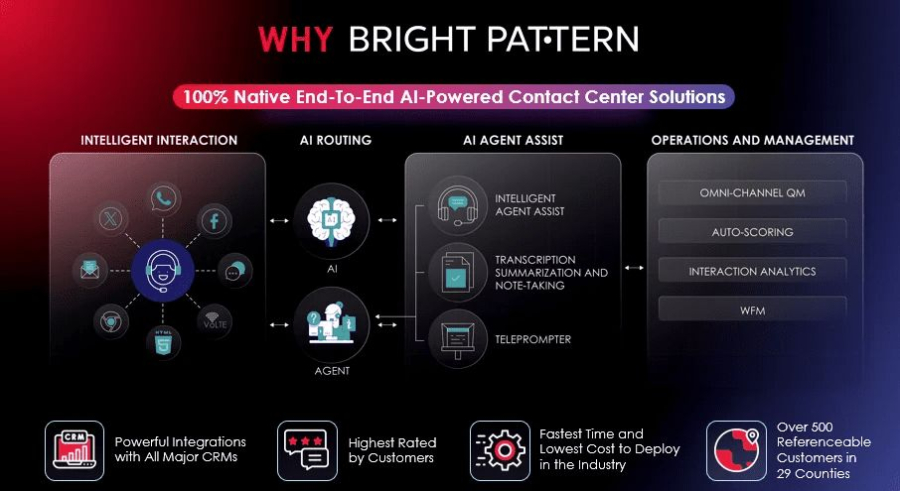
Bright Pattern leads the market in AI in contact center solutions, offering a cloud-based platform that combines automation, omnichannel support, and advanced analytics. Its intuitive interface makes it easy for businesses to implement AI tools without extensive technical expertise. Bright Pattern helps companies enhance agent productivity, reduce wait times, and deliver personalized customer experiences.
Key features include:
- Omnichannel routing for voice, chat, email, and social messaging
- AI-powered virtual agents and chatbots for automated responses
- Real-time speech and text analytics for monitoring agent performance
- Predictive engagement tools to anticipate customer needs
- Integration with CRM and marketing platforms for seamless workflows
Bright Pattern’s flexible platform is designed for businesses of all sizes, making it a top choice for organizations seeking a robust AI in contact center solution.
2. Genesys
Genesys offers AI-driven customer engagement tools that help contact centers automate routine tasks, optimize workflows, and provide insights through predictive analytics. Their AI features include chatbots, voice assistants, and sentiment analysis.
3. NICE
NICE provides a comprehensive contact center solution with AI capabilities for quality management, workforce optimization, and customer journey analytics. Its AI tools help businesses reduce handling times and improve customer satisfaction.
4. Talkdesk
Talkdesk combines AI automation with advanced analytics to streamline customer interactions across multiple channels. Its platform includes virtual agents, real-time reporting, and workflow automation to enhance agent efficiency.
5. 8x8
8x8 integrates AI into its cloud contact center platform to provide smart routing, sentiment analysis, and automated support. Their tools help reduce agent workload and improve response times.
6. RingCentral
RingCentral’s contact center solution leverages AI to deliver predictive analytics, intelligent routing, and self-service automation. It focuses on increasing agent productivity and ensuring consistent customer experiences.
7. Five9
Five9 provides AI-powered contact center software that supports omnichannel interactions, predictive dialing, and virtual agents. Their AI solutions are designed to improve first-call resolution and customer satisfaction.
8. Cisco Contact Center
Cisco offers AI-driven contact center solutions that focus on intelligent routing, virtual assistants, and analytics for real-time performance insights. Their platform is ideal for enterprises seeking scalable AI solutions.
9. Amazon Connect
Amazon Connect integrates AI and machine learning for speech recognition, natural language understanding, and predictive routing. It allows businesses to provide automated, personalized, and scalable customer support.
10. Avaya
Avaya’s contact center solutions include AI-powered chatbots, voice assistants, and analytics to optimize agent workflows and improve the overall customer experience.
